Introduction
Project status, scaffold, not battle-tested
BlueSploit is currently a scaffold-quality framework. Most modules
are CVE-aware probes / fingerprint matchers, not fully working
end-to-end exploits. A small number (Marc Newlin's keystroke-injection
family, the recon/DoS/post-ex set, csrk_signed_write,
smp_keysize_downgrade, the tool wrappers) are genuinely functional
today.
I, Mr-IoT (BlueSploit framework author), am rewriting modules
one at a time using real raw-HCI / raw-L2CAP / raw-SMP primitives so
that what each module claims to do is what it actually does on the
wire. No fake print_success("Exploited!"), no marketing CVE counts.
Treat current results as indicative until each module's page in these docs explicitly says "verified functional". Progress is tracked module-by-module, soon this will be a much stronger framework. Thanks for the patience.
Overview
BlueSploit is a Metasploit/RouterSploit-style framework for Bluetooth & BLE security research, written in Python. It offers security researchers, red teamers, and IoT pentesters an all-in-one solution for Bluetooth offense, Classic BT, BLE, BR/EDR, and vendor-specific stacks.
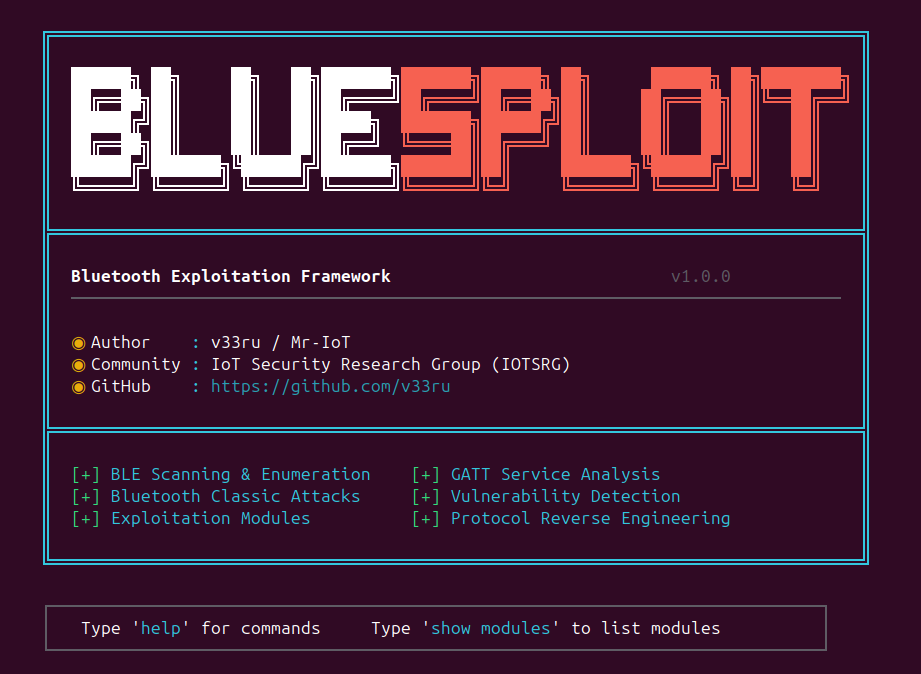
Perform reconnaissance, vulnerability scanning, and exploitation against:
- Bluetooth Classic (BR/EDR) devices
- Bluetooth Low Energy (BLE) peripherals
- Vendor stacks (Android Fluoride, BlueZ, Windows BT, HarmonyOS, Apple, Xiaomi, Airoha, OpenSynergy)
Main Features
- 101 modules covering 40+ public CVEs (KNOB, BIAS, BLUFFS, BLURtooth, BlueBorne, SweynTooth, BrakTooth …), coverage is broad, see the warning above for what's currently verified working
- Cross-platform: Linux (full), macOS (BLE)
- Hardware backends: Ubertooth One, HackRF One, nRF52840 sniffer, BTLEJack (micro:bit), YARD Stick One
- Metasploit-style REPL with
use/set/run/check/back - Auto-discovery loader, drop a
.pyfile intomodules/<category>/and it's available - Vuln scanner that maps device fingerprints to known CVEs
- GATT/SDP enumerators, BLE fuzzer, RPA deanon
- Post-exploitation: link-key dump, GATT exfil, session hijack, impersonation
Legal: For authorized security research, CTF, and pentesting only. See Legal Disclaimer.
Quick Links
| Section | Description |
|---|---|
| Installation | Install on Linux (any distro) and macOS |
| Quick Start | First scan + first exploit in 60 seconds |
| Video Tutorials | Walkthroughs and demos on YouTube |
| Console Commands | REPL reference (use, set, run, ...) |
| Engagement State | Persistent store: hosts, creds, workspaces |
| Module Categories | What lives in exploits/, scanners/, etc. |
| Hardware Setup | Ubertooth, HackRF, nRF52840, BTLEJack, YARD Stick One |
| Writing Modules | Author your own exploit / scanner |
| Troubleshooting | Common errors and fixes |
| FAQ | Quick answers |
| Contributing | PR + style guidelines |
What's in BlueSploit
69  exploits/     , CVE-backed PoCs (KNOB, BIAS, BLUFFS, BlueBorne, SweynTooth …)
10  dos/          , Bluesmack, L2CAP/RFCOMM/SDP floods
 6  auxiliary/    , Sniffers, fuzzers, RPA deanon
 5  scanners/     , Vuln scan, BlueBorne scan, hidden device scan
 6  recon/        , Discovery, GATT/SDP enum, OUI lookup, fingerprint
 5  post/         , Link-key dump, GATT exfil, session hijack
Architecture (high level)
bluesploit.py                # CLI entrypoint
core/
├── interpreter.py           # cmd2 REPL
├── loader.py                # auto-discovers modules under modules/
├── base.py                  # ExploitBase / ScannerBase / etc.
├── hardware.py              # Adapter abstraction (HCI, Ubertooth, nRF…)
└── utils/                   # printer, helpers
modules/
├── exploits/  scanners/  dos/  recon/  auxiliary/  post/
data/
├── wordlists/  oui/  profiles/  signatures/
See Architecture for the full breakdown.